The stock population of
Celestequest has increased by an estimated 50,000 in one day today. It was an epic undertaking and is only half complete, but it seems successful so far. When we took on half a dozen old beehives and started to do them up recently the grapevine, or rather the beehive, got buzzing and it was only a short time until our farrier discovered an unloved wild beehive free to a good home quite near our place. At the home of a very old friend in fact, where it bothered him whilst he shod horses. Very convenient. Almost unnervingly convenient for smallholders, but anyway we packed up tools, pressed a beekeeping friend into helper service and set off one fine, sunny day to see what we could see.

What we could see was a beehive in an old upturned whelping box in the loft of a very old pioneer barn. The rotten floorboards, the wave-like floor surface and the instructions not to touch the walls should they fall down only added to the excitement. As did the actual holes in the floor. Carting all the boxes, smokers and miscellaneous stuff up the fruit picking ladder now used as access was also interesting.

More interesting still was what, exactly, the new beekeepers would find in the whelping box. It was possible that it would be too heavy with honeycomb. There was only one thing for it. With the application of a lot of smoke, the lads gingerly turned the whole thing over. Contrary to expectations the air did not erupt in a storm of angry bees. They were not chased by annoyed little workers, nor was their an exodus of insects away from the site of destruction. It seems this swarm is a naturally docile one, and the whelping box, whilst beautifully decorated with fragrant folds of honeycomb, was not completely full of it. A sack of chaff left inside it several years ago had limited their building space.

Beekeepers
extraordinaires set to work to fill frames with honeycomb and encourage all the various types of bee (brood, workers, drones and hopefully the queen) to inhabit a standard domesticated beehive which, given that they'd nested in a white wooden box before, was not the huge leap that, say, tree-dwelling bees would have to make.

The careful transfer of comb, bees and honey took about an hour. Work has to be smooth and steady with bees - no sudden movements, rushing or too much sweating. On a sunny day up in the loft of an iron-clad barn clothed in nylon bee proof hoods this last part is not so easy. Plenty of looking and learning was also accomplished. My job was to fetch and carry, hand things over surgery-style when asked and provide helpful suggestions from a safe distance.

The rails in the whelping box, installed to keep the doggy mothers away from the walls and prevent puppy-smothering, were now a problem for honeycomb removal as the bees had found them a useful girder-like structure to build around. It was a healthy hive with a strong population a lot of whom were now returning laden with pollen and finding their commune torn apart by dome-headed white bears. As the afternoon wore on they added to the confused mass of bees on the wire, the floor, the tools, the whelping box and the new hives. For there ended up being three hives, to accommodate the sheer mass of honeycomb and bees. The designated beekeepers for the day put brood cells in each one and hopefully the workers will look after them all. The bees in the boxes who didn't score the queen should feed the brood royal jelly and make new queens. That is the plan. We're not sure if the bees are clear on the plan, but they got instructions.

Excess comb was hoarded in food-grade plastic buckets with sealable lids to keep out the bees cheekily trying to steal back their own honey. Even so, when we got the buckets home to extract the honey there were quite a few hitchhikers inside. We also ran short of box lids, not expecting to use so many base boxes, so one was improvised with a car mat from the floor of the trusty ute. We'll replace it with a proper one when next we check the bees. Given a few sunny days to assess the damage, organise work teams, remove the dead, start rebuilding and doing all the normal disaster-zone management things much better than humans could ever do, the bees should settle down. The next step will be to move the new hives around the tortuous hill routes to home, but we'll think about that tomorrow.


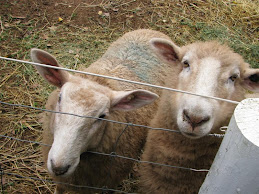
 Mid spring here can be warm and sunny bordering on hot but it occasionally has a tantrum and throws a thunderstorm. Rain was due today and down it came. It's beautiful and will fill the tanks again before the summer starts but a sudden cold change can be lethal for unprepared stock. This is what happened last year when a rainstorm came through the week after shearing:
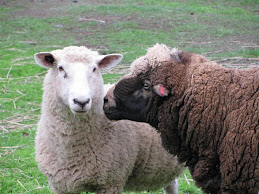
 We yarded the sheep out of the wind but they had a group shivering fit for a while anyway. Eventually the sun came out and warmed them up. Sheep have a reputation for being quite tough but the week after shearing is a critical time for them. Until they can grow a light covering of wool again they are actually as naked as we are. Just like we hunch up when cold, they stand like triangles and tuck up their tummies.
 They also get very sunburnt without their wool, especially the white ones with pink skin. This is another reason we keep them sheltered for that first week post disrobing. Otherwise we'd use buckets of sunblock lotion.




.JPG)
.jpg)

.jpg)
.JPG)

.jpg)
.jpg)
.jpg)

.jpg)
.jpg)